

How to Play and Win at Roulette
Roulette is a simple casino game that newcomers can learn without prior experience. If you want to understand how to play and make informed choices, start with the basic rules. The casino generally has the long-term mathematical advantage, so no system removes the underlying risk. Knowing the rules can help you choose bets more thoughtfully. This guide is for first-time players and anyone looking for practical information about roulette. It covers the core rules, main variations, bet categories, and online formats, with realistic expectations about how to play.
Roulette Basics

Roulette uses a wheel, a ball, and a betting table. The wheel has numbered pockets in different colours. The table shows those numbers and colours, along with spaces for the available wagers.
Choose a spot on the table based on where you think the ball may land. Online, place virtual casino chips on the corresponding betting areas. Options include higher-risk inside bets and outside bets, such as even-money wagers and bets that pay 2:1. The dealer spins the wheel and sends the ball around it.
The pocket where the ball lands determines which wagers win and lose. You can place one bet or several, covering as many selections as you like. Betting stays open until the dealer calls no more bets, which may be after the ball has already been spun around the wheel.
Risk and payout go hand in hand. A single-number bet pays more if it wins, but it is also more likely to lose.
How to Play Roulette: A Quick Step-by-Step Guide
Before going deeper into roulette’s rules, variations, strategies, and other details, it helps to understand the flow of a typical round.
- Choose your roulette bets on the table or on the betting overlay in an online game. Place your casino chips on the positions you want to cover. You can make one bet or several, with as many selections as you like.
- When the croupier calls time and says “no more bets,” they spin the roulette wheel and send the ball around its rim in the opposite direction.
- As the wheel slows, the ball drops into a pocket, determining the winning number. A selection you covered wins, whether it was a straight bet, split bet, odd or even, black or red, or another bet type.
- The croupier pays each winning bet according to its stated payout, including those placed by other players. Chips on losing bets are then collected from the roulette table.
- The dealer announces that betting is open again, and players can place roulette chips for the next round.
Roulette is easy to follow: choose your bets and wait for the ball to settle. Its accessibility helps explain why it is one of the most popular casino games; even a first-time casino visitor can quickly grasp the basic process.
Roulette Types, Wheels, and House Edge
Roulette tables look much alike in casinos and online, but there are three main versions. Their basic rules are similar, though important differences affect the wheel and house edge. American Roulette has the biggest disadvantage, so if French or European tables are available, those are generally worth choosing instead.
European Roulette
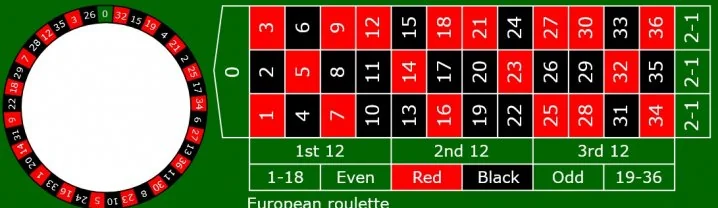
The widely played European roulette wheel has 37 pockets, numbered 0 through 36. As in other versions, the pockets alternate between black and red, while the single zero is green. The pattern continues around the wheel, with that one green zero as the only pocket of its colour.
The European roulette betting layout is also familiar. It includes inside bets such as straight, split, street, and corner, as well as outside options such as odd or even, red or black, and dozens.
European roulette house edge / RTP: 2.7% / 97.3%
European Roulette: Inside Bets Bet Type Description Payout Win Probability Straight-up (single number) Bet on one number. 35:1 1/37 or 2.70% Split (two numbers) Bet on two adjacent numbers, vertically or horizontally. 17:1 2/37 or 5.41% Street (three numbers) Bet on three numbers in a horizontal row. 11:1 3/37 or 8.11% Corner (four numbers) Bet on four numbers that meet at a corner. 8:1 4/37 or 10.81% Six line (or double street) Bet on two adjacent streets. 5:1 6/37 or 16.22% Trio Bet on the intersection of 0, 1, and 2, or 0, 2, and 3. 11:1 3/37 or 8.11% Basket Wager on 0, 1, 2, and 3 (a combination of a Trio and a Split). 8:1 4/37 or 10.81%
Note: These probabilities do not add up to 100% because players can also place outside bets, and the house edge slightly shifts the mathematical odds in the casino’s favor.
European Roulette Outside Bets Bet Type Description Payout Win Probability Red or Black Bet on all 18 red numbers or all 18 black numbers. 1:1 18/37 or 48.65% Even or Odd Bet on all 18 even numbers or all 18 odd numbers. 1:1 18/37 or 48.65% Low (1-18) or High (19-36) Bet on the first or second half of the numbers. 1:1 18/37 or 48.65% Dozens Choose one of three groups: 1-12, 13-24, or 25-36. 2:1 12/37 or 32.43% Columns Bet on one of the table’s three vertical columns, each containing 12 numbers. 2:1 12/37 or 32.43%
Note: If the ball lands on 0, all outside bets lose. This is what creates the house edge.
French Roulette
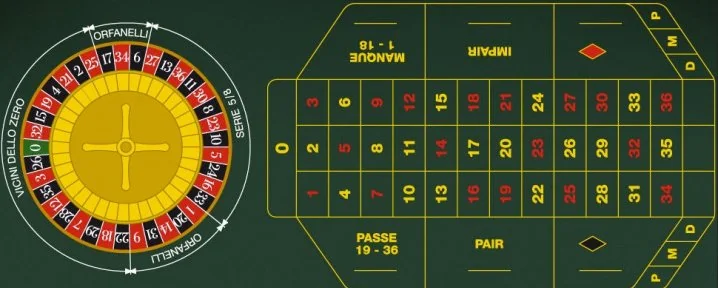
French Roulette is similar to European Roulette. It uses a single-zero wheel with 37 pockets numbered 0 to 36, and the board, bet types, odds, and payouts are largely alike. Its La Partage and en prison rules can lower the casino’s advantage on eligible even-money bets, bringing the approximate house edge to 1.35%.
When an even-money bet is placed and the ball lands on the green zero, La Partage may return half the original wager to the player. Under the En Prison rule, the wager instead remains in play for the next spin.
French Roulette House Edge / RTP: 1.35% (with the La Partage rule in effect) or 2.70% (when not in effect) / 98.65% or 97.3%
French Roulette Inside Bets Bet Type Description (French Term) Payout Win Probability Straight Up Bet on one number (En Plein). 35:1 1/37 or 2.70% Split Bet on two adjacent numbers, vertically or horizontally (Cheval). 17:1 2/37 or 5.41% Street Bet on three numbers in a horizontal row (Transversale Pleine). 11:1 3/37 or 8.11% Corner (or Square) Bet on four numbers that meet at a corner (Carré). 8:1 4/37 or 10.81% Six line (or double street) Bet on two adjacent streets (Sixaine or Transversale Simple). 5:1 6/37 or 16.22% Trio Bet on the junction of 0, 1, and 2 or 0, 2, and 3. This bet is similar in both versions. 11:1 3/37 or 8.11% Basket Wager on 0, 1, 2, and 3 (a combination of a Trio and a Split). 8:1 4/37 or 10.81%
French Roulette Outside Bets Bet Type Description (French Term) Payout Win Probability Red or Black Bet on all 18 red numbers or all 18 black numbers (Rouge or Noir). 1:1 18/37 or 48.65% Even or Odd Bet on all 18 even numbers or all 18 odd numbers (Pair or Impair). 1:1 18/37 or 48.65% Low (1-18) or High (19-36) Bet on the first or second half of the numbers (Manque or Passe). 1:1 18/37 or 48.65% Dozens Choose one of three groups: 1-12 (Première douzaine), 13-24 (Moyenne douzaine), or 25-36 (Dernière douzaine). 2:1 12/37 or 32.43% Columns Bet on one of the table’s three vertical columns, each containing 12 numbers (Colonne). 2:1 12/37 or 32.43%
American Roulette
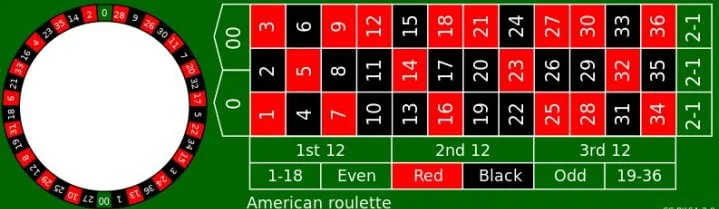
As the name suggests, American Roulette is commonly associated with land-based casinos in America. After roulette arrived in the country, casinos sought a larger advantage than the original game offered. Changes to the wheel increased the casino’s mathematical edge.
American Roulette differs from French and European Roulette by having 38 pockets—1 more than either of the other versions. Its additional pocket is green and marked double zero; the other wheels have one green zero pocket. These green pockets create the house edge. When the ball lands on 0 or double 0, most wagers lose. Zero is not odd or even, red or black, or high or low. It is excluded from standard bets unless a player chooses a wager that includes zero or zeros.
With two “levelers” on an American roulette wheel, the house edge increases from 2.7% on a single-zero European wheel to 5.26%.
American Roulette House Edge / RTP: 5.26% / 94.74%
American Roulette Inside Bets Bet Type Description Payout Win Probability Straight Up Bet on one number. 35:1 1/38 or 2.63% Split Bet on two adjacent numbers, vertically or horizontally. 17:1 2/38 or 5.26% Street Bet on three numbers in a horizontal row. 11:1 3/38 or 7.89% Corner (or Square) Bet on four numbers that meet at a corner. 8:1 4/38 or 10.53% Five Number (Top Line) Bet specifically on 0, 00, 1, 2, and 3. 6:1 5/38 or 13.16% Six line (or double street) Bet on two adjacent streets. 5:1 6/38 or 15.79%
Note: The extra “Five Number” or “Top Line” bet is unique to American Roulette. It is often discouraged because it has a higher house edge than other bets.
American Roulette Outside Bets Bet Type Description Payout Win Probability Red or Black Bet on all 18 red numbers or all 18 black numbers. 1:1 18/38 or 47.37% Even or Odd Bet on all 18 even numbers or all 18 odd numbers. 1:1 18/38 or 47.37% Low (1-18) or High (19-36) Bet on the first or second half of the numbers. 1:1 18/38 or 47.37% Dozens Choose one of three groups: 1-12, 13-24, or 25-36. 2:1 12/38 or 31.58% Columns Bet on one of the table’s three vertical columns, each containing 12 numbers. 2:1 12/38 or 31.58%
A Look at the Roulette Variants
The figures above help explain why many experienced roulette players prefer European and French roulette to the American version. The American double-zero wheel has a higher house edge, making it less appealing for long-term play. French roulette may be a better option when La Partage and En Prison apply; otherwise, European Roulette is generally the next choice. No version guarantees a win, though: choosing a wheel with a lower house edge only reduces the mathematical disadvantage.
How Roulette Betting Works
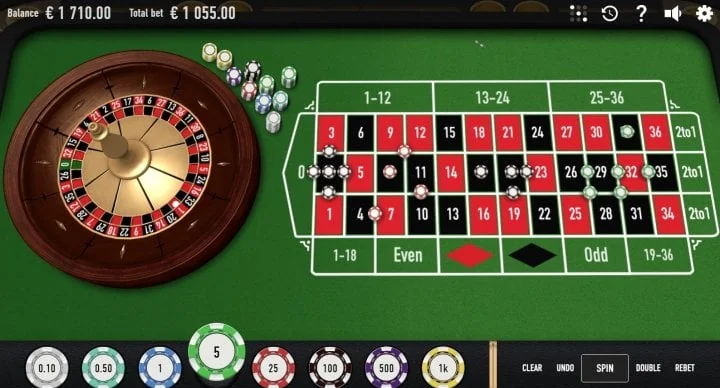
Roulette tables offer a range of bets on single numbers and groups of numbers. The basic trade-off is straightforward: bets that are more likely to lose generally offer larger payouts. For instance, a winning single-number bet pays more than an even-money bet.
Roulette wagers fit into three main categories: inside bets, outside bets, and announced bets. Inside and outside bets are standard options. Announced bets are usually associated with European and/or French roulette and may not be available at every casino.
These are the most common betting options on roulette tables:
Inside Bets on a Roulette Table
Inside bets go directly on numbers in the center of the table. They are called inside bets because the chosen numbers are within the main betting layout, surrounded by the other betting areas.
Inside bets come in several forms:
- The Straight-Up Bet: Also called a number bet, this covers just one number. It has the game’s highest payout, at 36x your bet.
- The Split Bet: Cover two neighbouring numbers on the table by placing your chip on the line between them. The payout is 18x.
- The Street Bet: This covers a row of three numbers. Place your chip on the row’s outside border. The payout is 12x.
- The Corner Bet: Cover four numbers in a block by placing your chip where their corners meet. The payout is 9x.
- The Six Line Bet: This covers six numbers in two adjacent horizontal rows. Place your chip where the outside borders of the selected rows meet. The payout is 6x.
- The Trio Bet: Cover 0, 1, and 2 or 0, 2, and 3 by placing your chip at the intersection of those numbers. This bet is available only in European/French roulette and pays 12x.
- The Basket Bet: This covers 0, 1, 2, 3, and 4. Place your chip where 0 meets the outside edge of the first row of numbers. This bet is available only in European/French roulette and pays 9x.
- The Top Line Bet: Cover 0, 00, 1, 2, and 3 by placing your chip along the outside border where the two rows meet. This bet is available only in American roulette and pays 7x.
Outside Bets on a Roulette Table
Outside bets use the areas around the numbered grid rather than individual number spots. These sections group numbers into broader selections that cannot be covered by placing a chip on just one number.
Because they cover larger groups, outside bets pay less than inside bets but have a higher chance of winning. In European/French roulette, these bets exclude 0; in American roulette, they exclude 0 and 00. If the ball lands in one of those pockets, the casino wins the wager.
The main outside bets are:
- Red or Black Bet: Choose a red or black number. The payout is 2x.
- Odd or Even Bet: Predict whether the ball will land on an odd or even number. The payout is 2x.
- High or Low Bet: Choose a number from 1 to 18 or from 19 to 36. The payout is 2x.
- Dozen bet: Choose one of three groups of twelve numbers: 1–12, 13–24, or 25–36. The payout is 3x.
- Column Bet: Choose one of the table’s three columns. The payout is 3x.
Announced Bets
Announced bets cover sections of the wheel itself. Because the wheel’s number layout is not shown directly on a standard table, players tell the dealer which wager they want to make.
Some tables have a racetrack, a special diagram of the wheel where players can place these bets visually. Announced bets are mainly associated with European/French roulette and are not available at every casino.
Popular Online Roulette Games

Roulette is offered at land-based venues and online casinos. Its easy-to-follow rules and relatively attractive house edge—except in American Roulette—help explain its enduring popularity. Online technology also makes more formats possible, including RNG roulette, where a random number generator sets the result, and live casino roulette streamed from a studio or venue.
Online casinos may offer these roulette formats:
- Regular French, American, and European Roulette Games: Standard French, American, and European roulette are the most familiar online table games. Their rules match the corresponding land-based versions. Table minimums and maximums vary, so choose limits that fit the bankroll you’ve set aside.
- Auto Roulette Games: This automated format is also found in live-casino settings. It can allow more bets per hour because a machine runs the wheel and a dealer does not pause the game.
- Speed Roulette Games: Speed Roulette offers a quicker pace and more rounds per hour. Betting windows are usually shorter, so players can place bets more often.
- Unique Roulette Games: Some online casinos also offer less traditional formats. Evolution’s Double Ball Roulette uses two balls. Multi-Wheel roulette runs multiple wheels, Mini Roulette offers a smaller version of the game, and Pinball Roulette uses a pinball machine to determine the winning number.
- Roulette Tables Streamed from Land-Based Casinos: Some online casinos stream roulette from a land-based venue, letting online players join a game alongside people seated at the table. Evolution, Ezugi, and Authentic Gaming are examples of live-casino suppliers offering this format.
Many online casinos have a broad selection. If you’re playing for the first time, a standard version can be a good place to learn the game before exploring less familiar options.
Random Multiplier Roulette Games

Random-multiplier roulette is especially popular in live-casino settings because it adds variable prizes to each round. Evolution’s award-winning Lightning Roulette was the first game of this kind, with multipliers from 50x to 500x the bet. Multipliers are assigned to randomly selected numbers and pay only if a player has placed a number bet, or straight-up bet, on one of them.
Other multiplier games include Mega Roulette (Pragmatic Play Live), Quantum Roulette (Playtech Live), and XXXtreme Lightning Roulette (Evolution). The potential for larger payouts comes with a trade-off: these games have a lower RTP, and therefore a higher house edge, to account for the multiplier feature.


Progressive Jackpot Roulette Games

Some online roulette games offer a chance to win a progressive jackpot. Like video slots with a progressive jackpot, they may award a very large prize. Progressive jackpots start with a seeded amount, such as £1 million on Mega Moolah, then grow as players place bets. A small portion of each wager goes into the pooled jackpot, which keeps growing until it randomly awards a player.
Ezugi offers Jackpot Roulette, Playtech offers Age of the Gods Roulette, and Microgaming/Games Global offers Mega Moolah Roulette. Mega Moolah Roulette is described as offering a progressive jackpot that pays out £7.5 million on average.
A Brief Guide to Popular Roulette Strategies
A separate roulette strategy guide covers these systems in more detail, so this overview is brief. The summaries below describe approaches used by professional and recreational roulette players.
- Martingale Strategy: One of roulette’s oldest and simplest betting systems, based on even-money bets.
- Labouchere Strategy: Also called the “Cancellation” or “Split Martingale” strategy, this approach is more complex and carries greater risk.
- Fibonacci Strategy: This system follows a betting sequence, doubling the bet after a loss and reducing it after a win.
- D’Alembert Strategy: Created by French mathematician Jean le Rond d’Alembert, this system resembles the Fibonacci approach: players double after a loss and return to their original bet after a win.
- Paroli Strategy: Also called the “Anti” or “Reverse” Martingale, Paroli aims to make the most of winning streaks.
- James Bond Strategy: Named after one of fiction’s best-known spies, this system places bets that cover a substantial portion of the roulette wheel.
No roulette strategy can guarantee a win because outcomes are still determined by chance. These systems can, however, give a session structure and provide a plan for placing bets.
Roulette Tips
You now have an overview of roulette rules, variants, and bets, and may be ready to play. If you’re not near a brick-and-mortar casino, an online casino roulette game may be more convenient. Consider these practical tips before you start.
- Practise with a free-to-play roulette demo: New players can practise without risking real money. A demo lets you get comfortable with the interface, placing bets, roulette odds, and how a round works. Free live-casino games are uncommon, but online casinos often offer demo modes for RNG roulette.
- Learn the rules of roulette: Don’t risk money until you understand how the game works. Learn the available bets, what it takes to win each one, and its odds and payout. Once you understand the game, decide how much of your roulette bankroll you’re prepared to use.
- Avoid American roulette tables: As noted earlier, American Roulette has twice the house edge of single-zero European Roulette because it adds a second green pocket, 00. When choosing a table, French or European roulette has the lower mathematical disadvantage.
- Check the table’s minimum and maximum bets: Limits differ from one table to another, so check them before joining. Choose a table that fits the bankroll you’ve planned for roulette.
- Start with even-money bets: Until you gain experience, you may prefer bets with a higher chance of winning. Even-money options such as red/black and odd/even pay less, but win more often than higher-risk bets. Later, you can try an odd-number bet or split bet, as long as you understand these wagers win less frequently despite their larger payouts.
- Consider a roulette strategy: The systems listed above can provide a structured plan, but none guarantees a win or a profitable session. They generally aim to take advantage of winning streaks or limit wagers during an unfavourable run; neither goal changes the underlying odds.
- Manage your bankroll carefully: This applies to every online casino game. Set aside enough for multiple rounds rather than staking it all at once. As a cautious guideline, aim to wager 5% or less of your bankroll per round. This leaves room to continue after a losing streak instead of running out of funds quickly.
- Expect that you’re more likely to lose: Don’t start a roulette session expecting to profit. The house edge gives the casino a mathematical advantage. Winning sessions happen, but over time the expectation is to lose against the house. Before playing, treat the money you set aside as money you may lose.
- Avoid playing while intoxicated: If you drink while playing, keep your judgment in mind. Intoxication can increase the chances of mistakes, chasing losses, and impulsive decisions. Complimentary drinks at many land-based casinos are one reason to take extra care and stay in control.
These habits can make a roulette session more organized and enjoyable, but they cannot overcome the house edge. Over the long term, losing money is more likely, even if a particular session ends in profit.
Conclusion
Roulette is easy to learn and can be entertaining. Its odds are not the best in the casino, though individual bets can win. Players can choose from a wide range of bets, table limits, and formats with random multipliers. As with any casino game, set a limit and know when to stop, especially when results are going against you.