

Roulette Strategies
Roulette is an exciting casino game, though its odds for players are among the least favourable. Roulette strategies may help you manage bets more deliberately, but none can ensure regular wins. Consistent profit isn’t realistic unless luck repeatedly favours you. Used with care, popular systems can add structure to a session, help you manage winning streaks and limit losses during losing runs. This guide covers widely used systems so you can compare their methods, risks and fit for your preferred style of play.

Getting Started with a Roulette Strategy
Before exploring the many systems available at online roulette tables, consider what you want from a strategy. Roulette takes patience and focus to understand, especially when you’re learning how different bets, odds and payouts work.
If you’re looking for a system to try at roulette, keep these points in mind:
- You may want to try several roulette strategies before finding one that suits you.
- Roulette systems come in different forms, and each type has advantages and drawbacks to consider.
- No roulette method guarantees a win, but understanding the odds and available bets can help you make informed decisions.
Understand That Roulette Doesn’t Pay Every Time
As with other casino games, roulette odds favour the house because of the house edge. Online casinos have the same mathematical advantage in roulette. Its edge is relatively modest compared with games such as video slots, though some table games, including blackjack, have a lower edge.
Over a long enough period, the house edge allows casinos to profit across their roulette tables. The game’s mathematics produces this result. Individual sessions can still end ahead, but outcomes and their effects on each player are random. You might double your bankroll in one session, while over time the casino can win that amount and more from the wider group of players.
So don’t expect a roulette system to make you win every time. Whatever approach you choose, chance remains the deciding factor.
Roulette Strategy Simulator
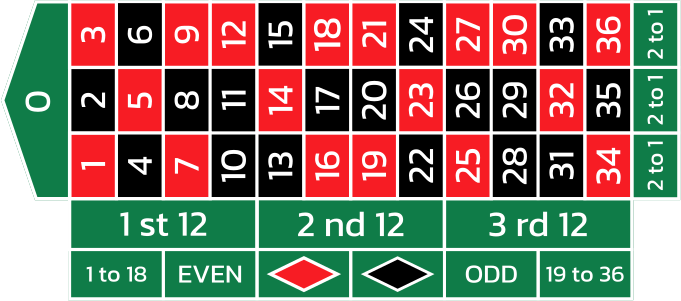
Add at least one table bet before running the simulation.
Test Summary ?
Balance Trend ?
Balance trend data will appear here after a test.
Result Per Spin ?
| Spin | Number | Status | Bet | Payout | Balance |
|---|
Spin results will appear here after a test.
Simulation History ?
| Test | P/L | ROI | Balance |
|---|
Your simulation history will appear here.
Factors That Influence Your Roulette Strategy
Several factors influence which roulette system suits your preferred style. These include table limits, the roulette variation and the bets you choose.
Betting Limits: Before choosing a roulette strategy, check the table’s minimum and maximum bets. This is especially important for progressive systems, which increase wagers after wins or losses. You need a low enough minimum and a high enough maximum to raise your stake several times before hitting the limit, since that restriction can prevent a progression from continuing.
Roulette Variants: Casinos offer several versions of roulette, and one variant has twice the house edge of the others.
- European Roulette: The house edge is 2.70%, equivalent to an RTP of 97.30%.
- French Roulette: French roulette also has a 2.70% house edge and a 97.30% RTP. When La Partage applies, however, the house edge is cut in half to 1.35%.
- American Roulette: Unlike the European or French wheel, the American wheel has an extra pocket: the double-green zero (00). Like the single zero, it cancels most bets, giving the casino an advantage. With two green pockets, American roulette has a 5.26% house edge, or a 94.74% RTP.
If you want better odds of winning, choose European Roulette or French Roulette instead of the American version. Consider American roulette only if there’s no alternative; otherwise, another table game may be a better choice.
Main Types of Roulette Strategies
Before exploring individual systems, it’s useful to sort roulette strategies into two broad groups. Each group takes a different approach to managing your wager:
- Progressive roulette strategies: These systems adjust the stake according to a set plan after each round. They require a bankroll able to withstand rising wagers, which adds risk. Martingale, Fibonacci and D'Alembert are well-known progressive strategies.
- Non-Progressive Roulette Strategies: Non-progressive systems are generally simpler to learn and use, though they still carry risk. As the name suggests, your wager stays the same each round. This may suit a limited bankroll or players who want tighter control over table limits.
If you’re new to roulette, starting with a non-progressive system may be sensible. Once you know the basics and have more experience, you can explore the progressive methods in this guide.
Popular Non-Progressive Strategies
Non-progressive systems don’t increase your stake after a round. Depending on the method, you either keep your wager steady or change it freely rather than following a set progression.
Constant-Bet Roulette Strategy
The constant-bet strategy is simple: make the same wager each time without changing its amount or the number you select. For example, you could bet $1 on “0” throughout your session.
This approach may keep you playing for a reasonable period and leave you a fair chance of finishing ahead, though it can’t change the underlying odds.
Constant-Proportion Roulette Strategy
The constant-proportion strategy is similar, but you bet a fixed percentage of your bankroll rather than the same cash amount each time.
As your balance increases, your wagers do too, giving you a chance to win more. If you lose, the calculated bets get smaller, which may help you stay at the table longer.
Andrucci Strategy
The Andrucci strategy is a higher-risk approach rather than a formal betting system. Watch the numbers that appear, play 30 rounds with a random straight bet each time, and note the winning numbers. The idea is that some numbers will pay out more often, but there’s no scientific evidence to support that assumption.
Review your notes, pick the numbers that appeared most often in those 30 bets, and place straight-up wagers on them.
All-In Roulette Strategy
The all-in strategy is particularly aggressive: you risk your entire bankroll on each spin, if you’re fortunate enough to get more than one spin.
James Bond Strategy
The James Bond strategy is another non-progressive system, devised by Ian Fleming in his book “Casino Royale.” You wager the same amount each round, spreading your bet across nearly half the table in an attempt to improve your chances of a hit.
Here’s an example of the James Bond roulette strategy using a total stake of €/$20:
- €/$1 on the green zero
- €/$14 on 19-36 (High Numbers) outside bet
- €/$5 on the 13-18 six-line (or double street bet)
Together, these wagers cover roughly two-thirds of the wheel or board, which might suggest a win 2 out of 3 times in theory, though random outcomes don’t follow a fixed pattern. You lose only if the ball lands on a number from 1 to 12.
The possible outcomes are:
- 1-12: You lose the full €/$20 stake.
- 13-18: You receive €/$25 at 5:1, for a €/$5 profit.
- 19-36: You receive €/$28 at 1:1, for a €/$8 profit.
- 0: You receive €/$35 at 35:1, for a €/$15 profit.
Popular Progressive Strategies
Progressive systems generally fall into three groups: positive progression, negative progression or regression, and flat progression. Unlike non-progressive methods, they adjust the stake based on the previous result. The terms describe both the direction of the change and why the wager is adjusted.
The Martingale Strategy
Calling the Martingale system the most successful roulette strategy would be a stretch, but it is certainly well known. The method is also used in other forms of gambling. Players apply it to even-money bets and Craps side bets, as well as Blackjack, Baccarat and online slots; it is also used in sports betting.
The Martingale roulette system is easy to follow: double an even-money stake after each loss. A win returns you to your original betting unit, after which you continue as usual. If you lose again, double the wager once more until you win, theoretically recovering your previous losses. Then reset to your starting stake. The drawback is that losing streaks require increasingly large bets, and eventually the table limit stops you from doubling again.
Here’s an example of one possible Martingale sequence:
Bet Number Bet Amount ($) Outcome Total Win/Loss ($) Accumulated Profit ($) 1 1 Loss -1 -1 2 2 Loss -2 -3 3 4 Loss -4 -7 4 8 Loss -8 -15 5 16 Loss -16 -31 6 32 Win 32 1
Note: In this Martingale example, six bets followed by a win on the sixth leave a net profit of $1.
Fibonacci Roulette Strategy
This system follows the same principle as the Fibonacci number sequence, where each new number is the sum of the two before it:
0, 1, 1 (0+1), 2 (1+1), 3 (1+2), 5 (2+3), 8 (3+5), 13 (5+8), and so on...
In roulette, the sequence sets the wager for each round, with each amount based on the sum of the previous two bets. A win moves you back two positions, while a loss moves you forward one number. The system starts with a $1 betting unit.
Bet Number Bet Amount ($) Outcome Total Return ($) Accumulated Profit ($) 1 1 Loss -1 -1 2 1 Loss -1 -2 3 2 Loss -2 -4 4 3 Loss -3 -7 5 5 Loss -5 -12 6 8 Loss -8 -20 7 13 Win 26 6
Note: In this Fibonacci example, seven bets followed by a win on the seventh produce a net profit of $6.
Reverse Martingale Strategy (Positive Progression)
The Reverse Martingale strategy, also known as the Paroli roulette strategy, is a positive progression system. It can create the opportunity for a larger win while keeping the pace relatively measured, potentially allowing a session to last longer.
Traditional Martingale is a regressive approach that increases your wager after each loss in an effort to recover previous losses. Statistically, this is more aggressive and can drain a bankroll quickly. Reverse Martingale instead aims to increase returns during a winning streak.
With Reverse Martingale, you increase the wager after a win, not a loss. The idea is to bet the amount you just won. If that wager loses, go back to the same small starting bet instead of raising it again.
Bet Number Bet Amount ($) Outcome Total Return ($) Accumulated Profit ($) 1 1 Loss -1 -1 2 1 Loss -1 -2 3 1 Win 2 0 4 2 Win 4 4 5 4 Loss -4 0 6 1 Win 2 2 7 2 Win 4 6
Note: This Reverse Martingale sequence results in a net profit of $6.
Progressive Fractional Roulette Strategy (Positive Progression)
Progressive fractional betting works much like Reverse Martingale, but it’s intended for players who don’t want to risk every dollar they’ve won. Instead of wagering the entire win, you bet only a portion of it, choosing the percentage yourself.
Bet Number Bet Amount ($) Outcome Total Return ($) Accumulated Profit ($) 1 1 Win 2 1 2 1.5 Win 3 2.5 3 2 Win 4 4.5 4 2.5 Loss -2.5 2 5 1 Loss -1 1 6 1 Loss -1 0 7 1 Win 2 2
Note: After 7 bets using the Progressive Fractional Roulette Strategy, including three wins followed by three losses, the stated net profit is $2.
D'Alembert Roulette Strategy (Negative Progression)
The D'Alembert strategy is another system players use in pursuit of a roulette win. It raises the betting unit by one after a loss and lowers it by one after a win. This is a relatively restrained approach: rather than doubling the stake, you adjust it by a single unit either way.
Bet Number Bet Amount ($) Outcome Total Return ($) Accumulated Profit ($) 1 1 Loss -1 -1 2 2 Loss -2 -3 3 3 Loss -3 -6 4 4 Win 8 2 5 3 Win 6 5 6 2 Win 4 7 7 1 Loss -1 6
Note: The D'Alembert Roulette Strategy example reports a net profit of $6 after 7 bets, consisting of three losses, three wins, and a final loss.
Labouchère Strategy (Negative Progression)
The Labouchère strategy is a regressive method that uses an additional sequence rule. It’s intended for even-chance bets such as red or black. Write a sequence of numbers representing your desired stakes, then bet the sum of the first and last numbers. After a win, remove those numbers; after a loss, add the previous wager to the end of the sequence.
For example, start with the sequence 1, 2, 3, 4, 5 and 6, then play the next few hands as shown below:
Bet Number Sequence Bet Amount ($) Outcome Total Return ($) Accumulated Profit ($) 1 1-2-3 4 Loss -4 -4 2 1-2-3-4 5 Win 10 6 3 2-3 5 Loss -5 1 4 2-3-5 7 Loss -7 -6 5 2-3-5-7 9 Win 18 12 6 3-5 8 Win 16 28
Note: After 6 bets with the Labouchère Strategy, clearing the entire sequence would leave a net profit of $28.
Hollandish Roulette Betting Strategy
The Hollandish betting system is another regressive approach. It increases your wager whenever a group of three equal bets results in a net loss. After each group, calculate the total profit or loss; if it’s negative, increase the next group by one unit. Continue until a group produces a net profit, then return to the original group stake and start again.
Bet Number Block Bet Amount ($) Outcome Total Return ($) Accumulated Profit ($) 1 1 1 Loss -1 -1 2 1 1 Loss -1 -2 3 1 1 Win 2 0 4 2 2 Loss -2 -2 5 2 2 Win 4 2 6 2 2 Loss -2 0 7 3 3 Win 6 6 8 3 3 Win 6 12 9 3 3 Loss -3 9
Note: Following the sequence above would produce a net profit of $9 after 9 bets.
Other Roulette Strategies and Systems
These are some of the most familiar roulette approaches. Players also try the following less common ideas at the table.
Covering the Table
This is not one formal system, but rather an approach that spreads wagers across a wider range of outcomes. For example, a player might bet on red, odd and the 1st 12 numbers. If all selections win, the payout can be substantial. If one or two lose but another wins, the loss may be lower than with a single isolated bet.
Column/Dozen Betting
Column/Dozen betting involves a single wager with a potential payout of 2:1. Choose one dozen or column, covering 1/3 of the wheel. On average, that selection should hit 1 in 3 times.
Double Street Quad Strategy
This combination covers nearly half the board. Place two double-street bets, each covering six numbers, plus one corner bet and one straight bet. Together, these bets cover 17 numbers.
Five Quad Strategy
A quad bet is placed at the centre of four numbers. For the five-quad strategy, make four quad bets and add one straight-up wager. This covers 21 numbers, so the chosen outcome is expected to appear more often than with narrower coverage, but there is no guarantee.
Tier et Tout Strategy
This system aims to take advantage of winning streaks. Decide how many chips to play with, then wager one-third of them on an even-money bet.
- If the bet wins, add the full profit to your starting pot and wager one-third of the new total on your next bet.
- If your first bet loses, wager the remaining two-thirds of your starting bankroll.
- If the pot is not evenly divisible by 3, round down and “bank” the remainder. Set that amount aside so the betting pool can still be divided into one-third and two-thirds.
Kavouras Bet
The Kavouras bet is a combination covering 20 numbers on the wheel. Bet one unit on 0, 1, 2, 3; two units on the double street covering 31, 32, 33, 34, 35, and 36; and one unit on each of the 8/11, 13/14, 15/18, 17/20, or 27/30 splits.
Oscar's Grind
Oscar's Grind uses a one-unit stake on an even-money bet until you are one unit ahead. A win reaches that target, so you return to the same stake. If you lose and then win, increase the wager by one unit only if that will not leave you in profit. Keep going until you are one unit ahead, then start the sequence over.
Shotwell Betting System
The Shotwell system spreads bets around the wheel instead of concentrating them on the table layout. Start with a six-line bet, then add straight bets on numbers, leaving no more than three numbers between your chosen selections. The goal is to distribute coverage around the wheel.
Dealer's Signature
Dealer's Signature is not strictly a strategy. It is based on the idea that some dealers release the ball at a consistent speed and angle, producing apparent patterns in the results. Players who follow this approach watch the dealer for such patterns and bet accordingly.
Column/Dozen Progressive Betting System
This approach applies a progression such as Martingale to column bets rather than even-money wagers.
How to Choose a Roulette Strategy
There are almost as many roulette systems as there are game variations. Before settling on one, practise and consider whether it suits the stakes and bankroll you plan to use. A system that feels manageable for one player may not work for another.
You can also weigh your decision by asking yourself:
- Are you new to roulette, or do you already have experience?
- How much is your bankroll, and can you afford to lose it?
- Why do you play roulette: for entertainment, to become more familiar with the game, or to try to make money?
After thinking through these questions, you can choose the roulette strategy that best fits your situation.
Our Top Roulette Playing Tips
Before trying any of these systems at online roulette, take a look at these practical tips. They may help you understand the game, manage losses and avoid common table errors. These are general roulette pointers, not rules for any particular system, though some can be paired with betting strategies.
Practise at Free Roulette Tables
As with almost any type of casino game, practising without risking money can be helpful. Demo RNG roulette games let you try betting systems without financial risk. If a method does not work, you have not lost money; once you understand how it works, you can decide whether to try it at a real-money table. You can also see whether a progressive or non-progressive approach suits you better.
Understand Your Roulette Game’s Rules
Roulette variations have different rules, bet types and odds, which can all influence your strategy. Differences go beyond French, American and European roulette: some newer games use two balls, while others include random multipliers. Learn the rules of the specific game before placing a bet.
Bet Smaller to Play Longer
Most roulette systems rely on following a betting pattern, so using your entire bankroll in just a few rounds leaves little opportunity to apply the method. Going all-in is the obvious exception, though it is hardly a system: win and carry on, or lose and walk away with nothing. Instead, choose a minimum stake that fits your bankroll and allows you to play many rounds. This gives you time to assess a strategy properly.
Think About Outside Bets
Many roulette systems, though not all, use outside bets such as odd/even, red/black even-money bets or 2 to 1 bets. These selections hit relatively often; even-money bets are essentially 50/50 wagers. That can make them a better fit for some systems than many other bets. New players may find outside bets easier to manage, whether or not they follow a formal strategy.
Read Online Casino Bonus Terms Carefully
Although online casino bonuses for table games such as roulette are not common, some offers may include them. Bonus funds may have higher wagering requirements, and match-deposit bonuses commonly count table games for a 5% - 20% contribution. Other promotions, such as cashback, may return part of a week’s roulette losses. Read each offer’s terms before counting a bonus as part of your bankroll.
Try Combining Bets
Beginners may prefer outside bets, while more experienced players might combine them with straight, dozen, column or snake bets. Split and corner bets can also cover particular wheel sections. These combinations spread your exposure across different outcomes, but do not eliminate the house edge or guarantee a win.
Ready to Play Roulette?

These are some of the best-known roulette systems and can add structure to your play. However, no roulette strategy is guaranteed to work, and players can lose over the long term. You may have winning sessions, but the odds remain against you over time.
A strategy that fits your preferred style can give you a clear betting plan. It cannot guarantee results, but it may help you manage your stakes, limit losses and decide how to handle a winning run.